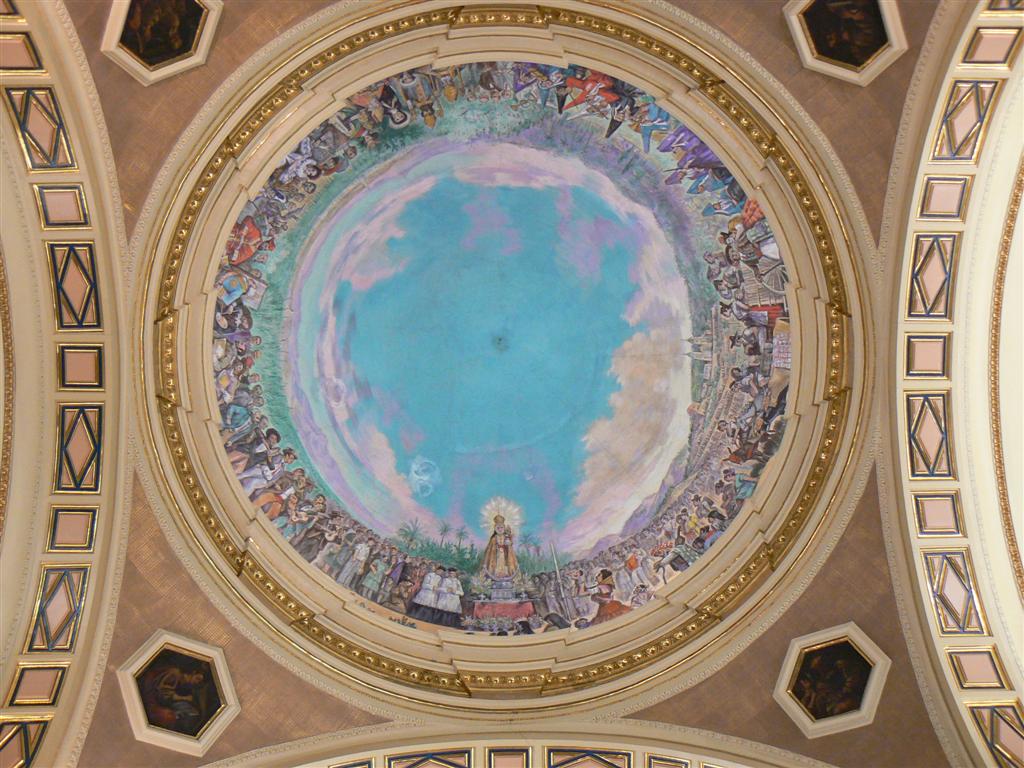
The designs and paintings that decorate the domes of many churches and other buildings in Murcia is something that has surprised us.
The architectural value of some of these buildings is limited, but heritage conservation usually gives pleasant surprises. If you visit a church, however simple it seems, do not forget to take a look at the ceiling. For now you can take a look at these pictures.
Los diseños y pinturas que decoran las cúpulas de muchas iglesias y otros edificios de Murcia es algo que nos ha sorprendido.
El valor arquitectónico de algunas de estas construcciones es limitado, pero la conservación del patrimonio suele dar sorpresas agradables. Si visita una iglesia, por sencilla que le parezca, no se olvide mirar al techo. De momento, puede mirar estas fotos.
Church of Santiago. Totana
Iglesia de Santiago. Totana
Church of Santiago. Totana
Iglesia de Santiago. Totana
The Fuensanta Sanctuary. Murcia
Santuario de la Fuensanta. Murcia
Church of San Javier
Iglesia de San Javier
Archbishop's Palace. Murcia
Palacio arzobispal. Murcia
Casino of Murcia
Casino de Murcia
viernes, 18 de enero de 2013
domingo, 13 de enero de 2013
jueves, 10 de enero de 2013
miércoles, 9 de enero de 2013
Biodiversity at Hacienda Riquelme / Biodiversidad en Hacienda Riquelme
I have been impressed from my very first visit to the resort, at the amount of wildlife to be seen.
Red Squirrels near the NW corner of the resort were nice to see on a recent visit.
In all, I have recorded a total of more than 200 animal species in and around the resort since I moved in.
Birds and Butterflies are seen in good numbers, but remarkably, the largest wildlife group present, appear to be the moths with, to date, over 90 different species positively identified and several other awaiting confirmation.
More importantly, the University of Murcia is using these records to add to a national database of moths seen in Spain.
To see the list of the identified moth species to end of 2012, click here. A xls file will open. It includes links to pictures and detailed info for every species.
John Girdley
Desde mi primera visita a Hacienda Riquelme quedé impresionado por la cantidad de vida silvestre vista.
Fue muy agradable ver ardillas rojas cerca de la esquina noroeste del resort durante una reciente visita.
En total, he registrado de más de 200 especies de animales en el resort y sus alrededores desde que vine aquí.
Aves y mariposas se ven en buen número, pero es de resaltar que el mayor grupo de vida silvestre presente resultan ser las polillas con, hasta la fecha, más de 90 especies diferentes identificadas positivamente y otras en espera de confirmación.
Más importante, la Universidad de Murcia esta usando estos registros para añadirlos a una base de datos nacional de polillas vistas en España.
Para ver la lista de especies de polillas identificadas hasta final de 2012, haga clic aquí. Se abrirá un archivo xls que incluye enlaces a imágenes e información detallada de cada especie.
John Girdley
Related posts / Entradas relacionadas
Everything that you do to the environment has a consequence / Todo lo que usted hace al medio ambiente tiene una consecuencia (Sept. 2010)
Does Hacienda Riquelme need an Environmental Policy? / ¿Necesita Hacienda Riquelme una normativa medioambiental? (Nov. 2010)
La vida silvestre a principios de noviembre / The wildlife in early November (Nov. 2012)
Moths and biodiversity in Hacienda Riquelme / Polillas y biodiversidad en Hacienda Riquelme (Ag. 2012)
Moths / Polillas (Ag. 2012)
Hidden treasures of the night (4) / Tesoros ocultos de la noche (4) (Oct. 2011)
Hidden treasures of the night (3) / Tesoros ocultos de la noche (3) (Sept. 2011)
Hidden treasures of the night (2) / Tesoros ocultos de la noche (2) (Nov. 2010)
Hidden treasures of the night / Tesoros ocultos de la noche (Nov. 2010)
The moths of Hacienda Riquelme / Las polillas de Hacienda Riquelme (Ag. 2010)
Red Squirrels near the NW corner of the resort were nice to see on a recent visit.
In all, I have recorded a total of more than 200 animal species in and around the resort since I moved in.
Birds and Butterflies are seen in good numbers, but remarkably, the largest wildlife group present, appear to be the moths with, to date, over 90 different species positively identified and several other awaiting confirmation.
More importantly, the University of Murcia is using these records to add to a national database of moths seen in Spain.
To see the list of the identified moth species to end of 2012, click here. A xls file will open. It includes links to pictures and detailed info for every species.
John Girdley
Desde mi primera visita a Hacienda Riquelme quedé impresionado por la cantidad de vida silvestre vista.
Fue muy agradable ver ardillas rojas cerca de la esquina noroeste del resort durante una reciente visita.
En total, he registrado de más de 200 especies de animales en el resort y sus alrededores desde que vine aquí.
Aves y mariposas se ven en buen número, pero es de resaltar que el mayor grupo de vida silvestre presente resultan ser las polillas con, hasta la fecha, más de 90 especies diferentes identificadas positivamente y otras en espera de confirmación.
Más importante, la Universidad de Murcia esta usando estos registros para añadirlos a una base de datos nacional de polillas vistas en España.
Para ver la lista de especies de polillas identificadas hasta final de 2012, haga clic aquí. Se abrirá un archivo xls que incluye enlaces a imágenes e información detallada de cada especie.
John Girdley
![]() |
| Hacienda Riquelme Moth List |
Everything that you do to the environment has a consequence / Todo lo que usted hace al medio ambiente tiene una consecuencia (Sept. 2010)
Does Hacienda Riquelme need an Environmental Policy? / ¿Necesita Hacienda Riquelme una normativa medioambiental? (Nov. 2010)
La vida silvestre a principios de noviembre / The wildlife in early November (Nov. 2012)
Moths and biodiversity in Hacienda Riquelme / Polillas y biodiversidad en Hacienda Riquelme (Ag. 2012)
Moths / Polillas (Ag. 2012)
Hidden treasures of the night (4) / Tesoros ocultos de la noche (4) (Oct. 2011)
Hidden treasures of the night (3) / Tesoros ocultos de la noche (3) (Sept. 2011)
Hidden treasures of the night (2) / Tesoros ocultos de la noche (2) (Nov. 2010)
Hidden treasures of the night / Tesoros ocultos de la noche (Nov. 2010)
The moths of Hacienda Riquelme / Las polillas de Hacienda Riquelme (Ag. 2010)
lunes, 7 de enero de 2013
Boletín de enero 2013 de Tomillo 5 / Tomillo 5, 2013 January Newsletter
The 2013 January Newsletter is already available in Tomillo 5 Website. In this issue, the cover story is the worrying increase of community fee debts in 2012.
El Boletín de enero de 2013 ya está disponible en Tomillo 5 Website. En este número, el tema de portada es el preocupante aumento de impagados de las cuotas de la comunidad producido en 2012.
viernes, 4 de enero de 2013
jueves, 3 de enero de 2013
Los cinco lagos de Hacienda Riquelme (4) / The five lakes in Hacienda Riquelme (4)
The photos below help you to compare the state of the lakes of the golf course on December 5-6, 2011 and on December 29, 2012. Click on any to enlarge. It is worth seeing the details.
We believe that the aesthetics of the resort depends largely on its lakes. The presence of birds also improves the aesthetics. Will the deterioration of the lakes continue? How much could the value of our properties be affected?
To locate each lake on the resort master plan see About our resort
Las fotos siguientes permiten comparar el estado de los lagos del campo de golf el 5-6 de diciembre de 2011 y el 29 de diciembre de 2012. Haga clic sobre cualquiera para ampliarla. Vale la pena ver detalles.
La estética del resort creemos que depende en buena medida de sus lagos. La presencia de aves también mejora la estética ¿Continuará el deterioro de los lagos? ¿Cuánto podría verse afectado el valor de nuestra propiedad?
Para situar cada lago en el plano del resort vea Sobre nuestro resort
Related posts / Entradas relacionadas
Los cinco lagos de Hacienda Riquelme (3) / The five lakes in Hacienda Riquelme (3) (November 3-4, 2012 / 3-4 noviembre 2012)
Los cinco lagos de Hacienda Riquelme (2) / The five lakes in Hacienda Riquelme (2) (September 2, 2012 / 2 septiembre 2012)
Los cinco lagos de H. Riquelme / The five lakes in H. Riquelme (December 5-6, 2011 / 5-6 diciembre 2011)
We believe that the aesthetics of the resort depends largely on its lakes. The presence of birds also improves the aesthetics. Will the deterioration of the lakes continue? How much could the value of our properties be affected?
To locate each lake on the resort master plan see About our resort
Las fotos siguientes permiten comparar el estado de los lagos del campo de golf el 5-6 de diciembre de 2011 y el 29 de diciembre de 2012. Haga clic sobre cualquiera para ampliarla. Vale la pena ver detalles.
La estética del resort creemos que depende en buena medida de sus lagos. La presencia de aves también mejora la estética ¿Continuará el deterioro de los lagos? ¿Cuánto podría verse afectado el valor de nuestra propiedad?
Para situar cada lago en el plano del resort vea Sobre nuestro resort
![]() |
| Lake next to phase 3 as seen from phase 4 (December 2011 and 2012) Lago junto a la fase 3 visto desde la fase 4 (Diciembre 2011 y 2012) |
![]() |
| Lake next to phase 2 and El Casón (December 2011 and 2012) Lago junto a la fase 2 y El Casón (Diciembre 2011 y 2012) |
![]() |
| The big lake as seen from El Casón (December 2011 and 2012) El lago grande visto desde El Casón (Diciembre 2011 y 2012) |
![]() |
| The big lake as seen from phase 1 (December 2011 and 2012) El lago grande visto desde la fase 1 (Diciembre 2011 y 2012) |
![]() |
| Lake between phase 1 and 2 (December 2011 and 2012) Lago entre las fases 1 y 2 (Diciembre 2011 y 2012) |
![]() |
| Lake next to phase 2 (December 2011 and 2012) Lago junto a la fase 2 (Diciembre 2011 y 2012) |
Los cinco lagos de Hacienda Riquelme (3) / The five lakes in Hacienda Riquelme (3) (November 3-4, 2012 / 3-4 noviembre 2012)
Los cinco lagos de Hacienda Riquelme (2) / The five lakes in Hacienda Riquelme (2) (September 2, 2012 / 2 septiembre 2012)
Los cinco lagos de H. Riquelme / The five lakes in H. Riquelme (December 5-6, 2011 / 5-6 diciembre 2011)
domingo, 30 de diciembre de 2012
Birds in Winter / Aves en invierno
We have already published a list of bird species that can be observed at the resort in every season. Now it is time for the birds of winter. A very high percentage of them are sedentary and they can be watched throughout the year.
Not everyone is interested in birds, but they are an asset to our resort that deserves to be valued and preserved (see The Birdlife of Hacienda Riquelme). Hopefully, as the lakes fill again this winter, the ornithological wealth we have enjoyed in previous years will recover. (see Birds and breakfast).
Any records of unusual birds in the winter would be very welcome (preferably with a photo). This is the least studied season.
Hemos ido publicando la lista de especies de aves que se pueden observar en el resort en cada estación. Ahora tocan las aves presentes en invierno. Un porcentaje muy alto de ellas son sedentarias y se pueden observar durante todo el año.
No a todo el mundo le interesan la aves, pero son un activo de nuestro resort que merece ser valorado y conservado (ver Las aves de Hacienda Riquelme). Ojalá que la evolución del estado de los lagos permita recuperar la riqueza ornitológica disfrutada en años anteriores (ver Birds and breakfast).
Cualquier registro de aves poco comunes en invierno sería muy bienvenido (preferiblemente con una foto). Esta es la temporada menos estudiada.
Related posts / Entradas relacionadas
The Birdlife of Hacienda Riquelme / Las aves de Hacienda Riquelme Recommended post! ¡Entrada recomendada!
Naturaleza y observación de aves / Nature and birdwatching
Birds in Late Spring / Aves a finales de primavera
Birds in Summer / Aves en verano
Birds in Early Autumn / Aves a principios de otoño
Birds in Late Autumn / Aves a finales de otoño
Birds and breakfast
La vida silvestre a principios de noviembre / The wildlife in early November
Not everyone is interested in birds, but they are an asset to our resort that deserves to be valued and preserved (see The Birdlife of Hacienda Riquelme). Hopefully, as the lakes fill again this winter, the ornithological wealth we have enjoyed in previous years will recover. (see Birds and breakfast).
Any records of unusual birds in the winter would be very welcome (preferably with a photo). This is the least studied season.
Hemos ido publicando la lista de especies de aves que se pueden observar en el resort en cada estación. Ahora tocan las aves presentes en invierno. Un porcentaje muy alto de ellas son sedentarias y se pueden observar durante todo el año.
No a todo el mundo le interesan la aves, pero son un activo de nuestro resort que merece ser valorado y conservado (ver Las aves de Hacienda Riquelme). Ojalá que la evolución del estado de los lagos permita recuperar la riqueza ornitológica disfrutada en años anteriores (ver Birds and breakfast).
Cualquier registro de aves poco comunes en invierno sería muy bienvenido (preferiblemente con una foto). Esta es la temporada menos estudiada.
Related posts / Entradas relacionadas
The Birdlife of Hacienda Riquelme / Las aves de Hacienda Riquelme Recommended post! ¡Entrada recomendada!
Naturaleza y observación de aves / Nature and birdwatching
Birds in Late Spring / Aves a finales de primavera
Birds in Summer / Aves en verano
Birds in Early Autumn / Aves a principios de otoño
Birds in Late Autumn / Aves a finales de otoño
Birds and breakfast
La vida silvestre a principios de noviembre / The wildlife in early November
jueves, 27 de diciembre de 2012
miércoles, 26 de diciembre de 2012
The Economist y la recuperación en España / The Economist and the recovery in Spain
Past December 19th, The Economist published the Special Christmas double issue including a short article entitled Spain’s prime minister. One year on. We copy the most positive paragraph in the article:
At least the bank rescue, at a cost of up to €50 billion, has so far turned out cheaper than was feared. Regional governments, which pushed the deficit off-target, are being tamed. And labour reforms allow wage cuts to make Spain more competitive. Predictions of recovery in 2014 are credible, even if Spaniards face a harsh 2013.
Other articles included in the same issue that we recommend are All hope not lost and, for those interested in history, The Holy Roman Empire: European disunion done right.
El pasado 19 de diciembre, The Economist publicó un número doble especial de Navidad que incluía un breve artículo titulado Spain’s prime minister. One year on. Traducimos el párrafo más positivo del artículo:
Al menos, el rescate bancario, con un costo de hasta 50 mil millones de euros, hasta el momento ha resultado más barato de lo que se temía. Los gobiernos regionales, que impulsaron el déficit fuera del objetivo, están siendo domados. Además, las reformas laborales permiten recortes salariales que hacen a España más competitiva. Las predicciones de recuperación en 2014 son creíbles, incluso si los españoles se enfrentan a un duro 2013.
Otros artículos incluidos en el mismo número que recomendamos son All hope not lost y, para los interesados en la Historia, The Holy Roman Empire: European disunion done right.
Related posts / Entradas relacionadas
The Economist y España / The Economist and Spain (June, 2012)
Simiocracia / Apecracy (July, 2012)
The Economist and the pain in Spain (August, 2012)
La crisis española desde un punto de vista diferente / A different view on the Spanish crisis (November 2012)
At least the bank rescue, at a cost of up to €50 billion, has so far turned out cheaper than was feared. Regional governments, which pushed the deficit off-target, are being tamed. And labour reforms allow wage cuts to make Spain more competitive. Predictions of recovery in 2014 are credible, even if Spaniards face a harsh 2013.
Other articles included in the same issue that we recommend are All hope not lost and, for those interested in history, The Holy Roman Empire: European disunion done right.
El pasado 19 de diciembre, The Economist publicó un número doble especial de Navidad que incluía un breve artículo titulado Spain’s prime minister. One year on. Traducimos el párrafo más positivo del artículo:
Al menos, el rescate bancario, con un costo de hasta 50 mil millones de euros, hasta el momento ha resultado más barato de lo que se temía. Los gobiernos regionales, que impulsaron el déficit fuera del objetivo, están siendo domados. Además, las reformas laborales permiten recortes salariales que hacen a España más competitiva. Las predicciones de recuperación en 2014 son creíbles, incluso si los españoles se enfrentan a un duro 2013.
Otros artículos incluidos en el mismo número que recomendamos son All hope not lost y, para los interesados en la Historia, The Holy Roman Empire: European disunion done right.
Related posts / Entradas relacionadas
The Economist y España / The Economist and Spain (June, 2012)
Simiocracia / Apecracy (July, 2012)
The Economist and the pain in Spain (August, 2012)
La crisis española desde un punto de vista diferente / A different view on the Spanish crisis (November 2012)
domingo, 23 de diciembre de 2012
Felices Navidades y Año Nuevo 2013 / Merry Christmas and Happy New Year 2013
jueves, 20 de diciembre de 2012
miércoles, 19 de diciembre de 2012
La Casa de Trastámara / The House of Trastámara
In the post Catherine of Lancaster, Queen of Castile it was explained how the House of Trastámara reached the throne of Castile. It was also told that the usurper dynasty was legitimized by the marriage of Catherine and Henry III of Castile, who were the parents of John II of Castile. After becoming a widow, Catherine was regent of the kingdom with his brother in law Ferdinand of Antequera.
Ferdinand of Antequera was a nephew of the King Martín I of Aragón. After his dead without any heir in 1410, Ferdinand was elected King of the Aragon’s Crown in the Compromise of Caspe in 1412, 600 years ago. The minutes of the Compromise show that the election was unanimous, although some historians claim he was poorly received in Catalonia.
Ferdinand, now Ferdinand I of Aragon, was the first King of the House of Trastámara in Aragon. His reign was brief but intense and fruitful, both in domestic and foreign policy. He died in 1416 and was succeeded by his son Alphonse V of Aragon and after he died, by his other son John II of Aragon.
John II of Aragon was the father of the future King Ferdinand II of Aragon, while his cousin and brother in law John II of Castile was the father of the future Queen Isabella I of Castile.
In the post The Middle Ages in Murcia. The Christian Rule it was explained how Isabella I of Castile and Ferdinand II of Aragon, through their marriage, joined the Castile and Aragon crowns. They also conquered the kingdom of Granada, ending with the Muslim political power in the Iberian Peninsula in 1492.
Isabella and Ferdinand, the Catholic Monarchs, lived in a time when Europe was in the transit from Middle to Modern Ages. They achieved huge successes in all areas, political, military, economic and social. Isabel also supported to Christopher Columbus (Ferdinand ignored the issue) with the result of America’s discovery, also in 1492.
Joanna I, Catholic Monarchs’ daughter, was the last queen of the House of Trastámara, leading, through her son Charles I, to the Habsburg Spain.
Catherine of Aragon was another daughter of Isabella and Ferdinand, and also unhappy first wife of King Henry VIII of England.
TVE 1 has recently broadcast the first season of Isabel, a series on Isabella I of Castile. It has an excellent script, advised by leading historians. It is available on the website of RTVE, along with plenty of information. To access it, click here.
We thank A. Vílchez, PhD in History, for his support.
En la entrada Catalina de Lancaster, Reina de Castilla contamos cómo la Casa de Trastámara llegó al trono de Castilla. También dijimos que la dinastía usurpadora se legitimó gracias a la boda de Catalina y Enrique III de Castilla, que fueron los padres de Juan II de Castilla. Tras enviudar, Catalina fue corregente del reino con su cuñado Fernando de Antequera.
Fernando de Antequera era sobrino del rey Martín I de Aragón. Tras morir éste sin sucesión en 1410, Fernando fue elegido rey de la corona Aragón en el llamado Compromiso de Caspe en 1412, hace 600 años. Las actas del Compromiso dicen que su elección se hizo por unanimidad, aunque algunos historiadores afirman fue mal recibido en Cataluña.
Fernando, ahora Fernando I de Aragón, fue el primer rey de la Casa de Trastámara en Aragón. Su reinado fue breve pero intenso y fructífero, tanto en política interior como exterior. Murió en 1416 y le sucedió su hijo Alfonso V de Aragón y, tras la muerte de éste, su otro hijo Juan II de Aragón.
Juan II de Aragón fue el padre del futuro rey Fernando II de Aragón, mientras que su primo y cuñado Juan II de Castilla fue el padre de la futura reina Isabel I de Castilla.
En la entrada La Edad Media en Murcia. El dominio cristiano contamos como Isabel I de Castilla y Fernando II de Aragón lograron con su boda la unión de las coronas de Castilla y Aragón y conquistaron el reino de Granada, poniendo fin al poder político musulmán en la Península Ibérica en 1492.
Isabel y Fernando, los Reyes Católicos, vivieron en la época en que Europa pasaba de la Edad Media a la Moderna. Alcanzaron inmensos logros en todos los ámbitos, político, militar, económico y social. Además, Isabel apoyó a Cristóbal Colón (Fernando se desentendió del tema) con la consecuencia del descubrimiento de América, también en 1492.
Juana I, hija de los Reyes Católicos, fue la última reina de la Casa de Trastámara, dando paso, a través de su hijo Carlos I, a los reyes de la Casa de Austria.
Otra de las hijas de Isabel y Fernando fue Catalina de Aragón, desgraciada primera esposa del rey Enrique VIII de Inglaterra.
Recientemente, TVE 1 emitió la primera temporada de Isabel, serie sobre Isabel I de Castilla. Cuenta con un excelente guion, asesorado por prestigiosos historiadores. Está disponible en la web de RTVE, junto con abundante información complementaria. Para acceder a ella haga clic aquí.
Agradecemos a A. Vílchez, doctor en Historia, su asesoramiento.
Ferdinand of Antequera was a nephew of the King Martín I of Aragón. After his dead without any heir in 1410, Ferdinand was elected King of the Aragon’s Crown in the Compromise of Caspe in 1412, 600 years ago. The minutes of the Compromise show that the election was unanimous, although some historians claim he was poorly received in Catalonia.
Ferdinand, now Ferdinand I of Aragon, was the first King of the House of Trastámara in Aragon. His reign was brief but intense and fruitful, both in domestic and foreign policy. He died in 1416 and was succeeded by his son Alphonse V of Aragon and after he died, by his other son John II of Aragon.
John II of Aragon was the father of the future King Ferdinand II of Aragon, while his cousin and brother in law John II of Castile was the father of the future Queen Isabella I of Castile.
![]() |
| Click in the figure to enlarge |
Isabella and Ferdinand, the Catholic Monarchs, lived in a time when Europe was in the transit from Middle to Modern Ages. They achieved huge successes in all areas, political, military, economic and social. Isabel also supported to Christopher Columbus (Ferdinand ignored the issue) with the result of America’s discovery, also in 1492.
Joanna I, Catholic Monarchs’ daughter, was the last queen of the House of Trastámara, leading, through her son Charles I, to the Habsburg Spain.
Catherine of Aragon was another daughter of Isabella and Ferdinand, and also unhappy first wife of King Henry VIII of England.
TVE 1 has recently broadcast the first season of Isabel, a series on Isabella I of Castile. It has an excellent script, advised by leading historians. It is available on the website of RTVE, along with plenty of information. To access it, click here.
We thank A. Vílchez, PhD in History, for his support.
![]() |
| RTVE. Página de la serie Isabel |
Fernando de Antequera era sobrino del rey Martín I de Aragón. Tras morir éste sin sucesión en 1410, Fernando fue elegido rey de la corona Aragón en el llamado Compromiso de Caspe en 1412, hace 600 años. Las actas del Compromiso dicen que su elección se hizo por unanimidad, aunque algunos historiadores afirman fue mal recibido en Cataluña.
Fernando, ahora Fernando I de Aragón, fue el primer rey de la Casa de Trastámara en Aragón. Su reinado fue breve pero intenso y fructífero, tanto en política interior como exterior. Murió en 1416 y le sucedió su hijo Alfonso V de Aragón y, tras la muerte de éste, su otro hijo Juan II de Aragón.
Juan II de Aragón fue el padre del futuro rey Fernando II de Aragón, mientras que su primo y cuñado Juan II de Castilla fue el padre de la futura reina Isabel I de Castilla.
![]() |
| Haga clic en la figura para ampliarla |
Isabel y Fernando, los Reyes Católicos, vivieron en la época en que Europa pasaba de la Edad Media a la Moderna. Alcanzaron inmensos logros en todos los ámbitos, político, militar, económico y social. Además, Isabel apoyó a Cristóbal Colón (Fernando se desentendió del tema) con la consecuencia del descubrimiento de América, también en 1492.
Juana I, hija de los Reyes Católicos, fue la última reina de la Casa de Trastámara, dando paso, a través de su hijo Carlos I, a los reyes de la Casa de Austria.
Otra de las hijas de Isabel y Fernando fue Catalina de Aragón, desgraciada primera esposa del rey Enrique VIII de Inglaterra.
Recientemente, TVE 1 emitió la primera temporada de Isabel, serie sobre Isabel I de Castilla. Cuenta con un excelente guion, asesorado por prestigiosos historiadores. Está disponible en la web de RTVE, junto con abundante información complementaria. Para acceder a ella haga clic aquí.
Agradecemos a A. Vílchez, doctor en Historia, su asesoramiento.
domingo, 16 de diciembre de 2012
Turismo en la Región de Murcia / Tourism in the Region of Murcia
If you wish to travel somewhere, you will probably wonder about your destination: What to see? What to do? Where to eat? Where to stay? And of course, how to fly there?
The application and social network for travellers Minube has been designed (in Spain) to answer the above questions as clear and direct as possible. To see some examples of the available information about Region of Murcia click the links below.
English links: Region de Murcia, Beaches, Golf Courses, Museums, Castles
Si usted quiere viajar a un sitio probablemente se pregunte sobre su destino: ¿Qué ver? ¿Qué hacer? ¿Dónde comer? ¿Dónde dormir? y por supuesto ¿Cómo volar allí?
Para responder a las preguntas anteriores de la forma más clara y directa posible, se ha diseñado (en España) la aplicación y red social para viajeros Minube. Para ver algunos ejemplos de la información disponible sobre la Región de Murcia haga clic en los enlaces siguientes.
Enlaces en español: Región de Murcia, Playas, Campos de Golf, Museos, Castillos
The application and social network for travellers Minube has been designed (in Spain) to answer the above questions as clear and direct as possible. To see some examples of the available information about Region of Murcia click the links below.
English links: Region de Murcia, Beaches, Golf Courses, Museums, Castles
![]() |
| What to see in Murcia |
Para responder a las preguntas anteriores de la forma más clara y directa posible, se ha diseñado (en España) la aplicación y red social para viajeros Minube. Para ver algunos ejemplos de la información disponible sobre la Región de Murcia haga clic en los enlaces siguientes.
Enlaces en español: Región de Murcia, Playas, Campos de Golf, Museos, Castillos
![]() |
| Museos en Región de Murcia |
viernes, 14 de diciembre de 2012
Suscribirse a:
Entradas (Atom)


.jpg)


.jpg)